04 October 2011

Delving into the Custom Dictionary


During one of the more boring moments at work I was writing up a word document when a squiggly little red line informed me that it had little to no idea what I was trying to say (I was saying ‘Guinnessland’ that particular time, so I'm not surprised). But as I am wont to do, I added the word to my custom dictionary, and kept on writing my emails. Then as the work died down, and my propensity for procrastination took over, it got me thinking.
I use my personal dictionary a lot. Of late I have even been entering in misspelt word just for the heck of it; whether this is latent mischievousness laid out for the unwitting persons who inherit my computer, or if I just find it quicker to skip some corrections in a spell check, I don’t know. But the fact remains; I was bored and thinking of my custom dictionary. I decided to track it down, and after a quick windows search, had the small text file in my virtual hands.
It contained 507 entries, many of which were the standard and expected values, however there were a bunch of quirky, or random entries that really got me thinking. As I read further I began organising them in my head, and was amused to see how a small picture of the person I am could be built out of such a thing. So for my own amusement, and now perhaps dear reader for your own curiosity, I have compiled a few interesting examples below.

As a highlight of my dislike in giving predictions of when I will do things I have added 4ish, 5ish, and Soonish

There are the expected references to new companies, websites or programs which enter the cultural zeitgeist a bit quicker than Microsoft Word can follow, such as BitTorrent, facebook, Gizmodo, GoodReader, Lifehacker (Note there is not mention of tweet or twitter as they are their own words already); not to mention new products weaselling their way into my lexicon like the ubiquitous iPad and iPhone.

There are the ones I just have plain no idea why I added them (though I imagine it was the same source of much of my office ‘work’; boredom), the prime example being Alakfhlahvfoisg.

Word is never good at picking up any onomatopoeia in writing, especially those with an undefined length, so I did my best to cover some random ones, such as:
Hmmmm, Hmmmmm, Hmmmmmm, Hmmmmmmm, Mmmmmm, Mmmmmmm, Numnumnumnum, Ummm, wooo, Wooo, Urgh, Booyah
(Note the capital ‘Wooo’ appears distinct from the lowercase ‘wooo”. This must have been important at some time)

There were things that I have since had to look up again to understand why I added them, like Haufniensis, a pseudonym used by Søren Kierkegaard in writing some of his philosophical works. Or Centaurus, a group of stars which for some reason warranted not only their conclusion in something I was writing, but the added safety of including their spelling in future missives. And even ones like parsimology, which though it sounds awfully important, I'm still not quite sure what it is.

I mentioned the odd movie, TV show, or character, which found its way to the mathewonary including Borat, Caddyshack, Dragonball, Hellboy, and Rainman
(Note: mathewonary is now also in the mathewonary; so it is a self-referential beast now)

Some obscure technical words like Necrocracy, Correlogram, Eigenvalues and Compatibilism came in usually from me doing a bit of homework in my spare time. Or some less than technical words snuck in, including weeing or Thingie. Not to mention the almost oxymoronic Thinkability.

A bunch of words I made up by a quick addition or extrapolation also found their way in, under a heading which itself also comes from the list; Mathewisms like Guinnessland or Liztastic.

There was also a lot of slang, or jargon (is that the right usage of the word? I highly doubt it), or generally just words I apparently use a lot but aren’t quite proper English, like Gotta, Idiotish, Indeedy, killin, nerding, or problemo.
(Note: the ‘killin’ entry shouldn’t be cause for concern; it combines with the ‘nerding’ term, in the sense that I am sometimes ‘nerding it up doing some killin on the xbox’.)

Sometimes words just need that extra bit of emphasis, as evidenced buy the inclusion of Cooooooooool and neeeeeeed in my custom lexicon.

Peoples names inevitably found their way in, whether they be famous individuals which shed some light on those I may admire (Dawkins, Gervais, Hitchens), parents and friends (Harley, Hutchy, Harrison (the number of times Word suggested I meant to call my son ‘Garrison’ seemed to turn into an insult)) or even my own name, which everyone in the world constantly suggests to me is missing that superfluous extra 't' (Mathew).

Then there were the oddballs. Like the twitter tag GamerDadLikes, the adjective that most people would like to avoid (Hitleresque), the worrying inclusion of the verb Sweatingly, the Orwellian Thoughtcrimes, or the just plain strange presence of the suspect profession; xenobiologist.

And thus ends the strange expedition into my custom dictionary.
Thanks for stopping by.
MM

03 October 2011

Bhutan and its Quest for Gross Domestic Happiness


Bhutan sounds like quite a nice little country. Nestled away in Central Asia, just east of Nepal, it is a place steeped in a kind of mystical quality; some sort of cultural permanence whereby it seems to us to be separate from the world in its society, its culture, and in its way of functioning. Indeed it has often been referred to as The Last Shangri-la, and is a magnet for people interested in experiencing it’s heavily Buddhist influenced culture.
They also drive on the left side of the road.
Looking in to travelling there you might notice the exorbitant costs levied by its government ($200USD a day in order to stay there!), and think it a negative signal of the government within; perhaps they are prone to extortion, or trying to hold back the world from its people, a la the communist strongholds of last century.
However looking into it further, you will find this is far from the truth.
The disincentives for tourists to visit the country are put in place for the happiness of its people, not simply for their isolation. An influx of tourists would potentially damage not only the environment of the diminutive country, but also its cultural integrity (or at least so says the government). Granted though this might sound like any authoritarian governments excuse, other evidence on the matter points to a more cordial answer, as the government’s commitment to happiness is more than a mere catchphrase.
The Bhutanese government’s dedication to the pursuit of happiness for its population is evident when you look at their recent actions.
Not content with simply making the pursuit of happiness a right as it is in the United States; something to be taken up by the individual, and protected by the government. The Bhutanese government actively sets about increasing the happiness of its people, and making their happiness an essential part of governing.
Indeed they were recently the initiating force in getting the pursuit for happiness recognised as an international human right, and are the only country on earth which actively tries to measure the happiness of its population in any meaningful sense (though how possible this is, is up for debate).

Now I know what you may be thinking; don’t all governments seek to increase the happiness of their populous?
And in a sense you are right, but what sets Bhutan apart from the rest is how willing they are to take a right which may or may not be exercised by it citizens, and turn it into a right which is to be not only facilitated by the government, but also encouraged.
You see governments like ours work for the happiness of its citizens in a roundabout, or indirect way. We ensure that business owners can run their businesses in a profitable way, and be protected from (apparent) threats from abroad. We keep workers safe from injustice in the workplace be ensuring employers adhere to regulations. We provide people with services in any number of ways to ensure that they can maintain healthy, safe and prosperous lives. But at the heart of these initiatives there is rarely a desire for increasing the overall happiness as an overt goal.
In a sense Bhutan’s government has put in place measures to protect its citizen’s happiness in much the same way that other countries seek to protect their environment.
Bhutan’s government has a checkpoint through which any budding policies must pass, where its impact on the gross domestic happiness is analysed, and should it be found to threaten this, the panel has the authority to strike it down, and send it back for adjustment. This is done in the form of Gross National Happiness impact statement, much like the Environmental Impact Statements that accompany major development works in our country.
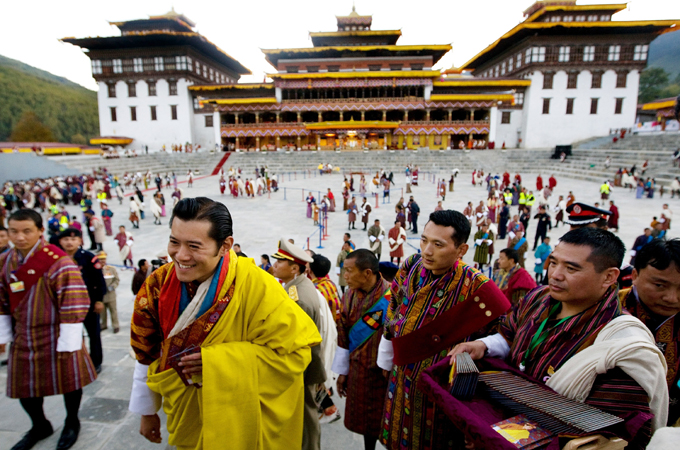
The countries current Prime Minister Jigme Y Thinley is a driving force in this push for happiness being a goal of the government. If you are sceptical of his conviction, just take a look at him leading a National Happiness Commission procession in the photo below (hint: he is the one sporting the massive grin).
He recently spoke at the opening of a conference hosted in the Himalayan kingdom specifically convened to discuss "Economic Development and Happiness". Indeed the Prime Minister organised the global conference which was co-hosted by Jeffrey Sachs, Director of The Earth Institute at Columbia University and Special Adviser to United Nations Secretary-General Ban Ki-moon; and indication that this conference wasn’t just for show.

All this being said of course, there are downsides to this kind of governing. For instance, other countries don’t necessarily have statements about how to pursue the gross national happiness of their populations because happiness is such a subjective term. What makes me happy might, if forced upon you, make you unhappy. Indeed the bigger the country, the harder it is to for such a cohesive statement of national preference. In the small kingdom of Bhutan it is a bit easier, specifically when the government’s determination of happiness factors relies heavily on the shared culture of the Buddhist constituents.
However that in itself causes another, more sinister problem.
Take for instance the late 1980s and early 1990s, when the country expelled nearly one fifth of its population in the name of preserving its Tibetan Mahayana Buddhist culture and identity; something which it sees as intrinsic to its happiness. One wonders here if the overall happiness of the country being increased at the expense of a minority is worth it. In fact, one shouldn’t have to wonder; it should be perfectly clear.

In another instance, Bhutan was one of the last countries to introduce television to its constituents, with the ban on television and the Internet only being lifted in 1999. This was again in part due to the worries that the influence of these factors on the population could put Bhutan’s traditional cultural aspects at risk.
Though in this case the weighing up of the potential benefits for the overall happiness of the population, versus the possible unhappiness caused by a cultures adaptation to new influences, resulted in a win for the introduction of these influences. This placed of the nation’s growth as a happier independent country above that of the mere stagnant enforcement of previous cultural norms, which always seems a good sign to me that the government is still working for the people, not simply ruling over them.

Last year Bhutan became the only country to ban the sale of tobacco within its borders. Citizens are welcome to buy it in neighbouring India, and can smoke in public; however they must carry their receipts with them, or else risk running afoul with the law. This move was seen as being overall beneficial for the gross Domestic Happiness of Bhutan, even though it may be at the expense of the overall Gross Domestic Product of the Bhutanese. Whether or not you agree with the rationale behind banning tobacco sales, it is still interesting to see a government which bases its arguments partly around impacts on happiness, and not just on the wallet.

But it is all well and good to speak of these things in theory. The true test of Bhutan’s quest for Gross National Happiness maximisation is written in the fuzzy hand of statistics.
A study by Adrian G. White of the University of Leicester titled "A Global Projection of Subjective Well-being: A Challenge to Positive Psychology?" sought to rank the different nations of the world using the common metric of Subjective Well-Being. Out of the 178 countries analysed, Bhutan took the number eight spot on the list, and was the highest of all Asian countries. This is no small feat considering out of the top twenty countries, it was the only one with a significantly low Gross Domestic Product (with a GDP per capita of only $1,978).

So while I am not putting this form of governing forward as a panacea for all our trouble, I still think it is an interesting thing to see in practice.
MM

29 September 2011

Creepy Church Sign

Whenever I visit my parents in Magpie I make sure to check the sign this church has out the front of its grounds. You know the kind where they have their uplifting message, or their prosthelytising tracts, or the kind on the Simpsons that always has an amusing message.
Well when I saw this the other day, I knew I would have to stop next time and take a photo, its just so odd and creepy; something which would seem more at home in a message from a stalker, written with cut out letters from magazines.
Check it out:
Did i mention he is supposedly watching you; all the time......
Seriously? What is the message this is trying to get across? I mean I understand the reference being that Jesus got himself killed for the sins of all mankind. But does it really need to try and link itself to ones perception of their appearance?
I don't really have much more to say on the subject; what do you all think?
MM


Is it Quote-worthy or Just Crazy?

I have one of those standard day-a-page calendar things on my desk at work, and every date is emboldened with some quote or words of wisdom from one source or another. Generally they are interesting, sometimes they are inspiring, but some days I really wonder if the people compiling this list are really putting thought into it, or are they just grabbing anything that sounds quoteworthy, in order to fill the required 365 days of a year.
Take today’s instalment for instance:
 “Health is not a condition of matter, but of mind” – Mary Baker Eddy
At first I thought this interesting, perhaps it was a take on perception, or the true meaning of health. But then the more cynical side of me won over, and I began to wonder what came of old Mary, and would she have still shared this view if her health had failed her.
A quick glance at Wikipedia seemed to confirm my wariness; she was the founder of the Christian Science religion.
Now I am an atheist, and quite critical of religion in all its guises, but don’t think that I am being too quick to judge here solely on her Christian nature. Christian Science is at best a ridiculous superstition, and at worst a dangerous and immoral practise.
The crux of Christian Science ‘thinking’ revolves around the fact that Jesus didn’t use drugs, or employ any hygiene measures in promoting health, and as such they must not be necessary. Eddy and her sect instead believe that all illnesses can be overcome through proper knowledge of God, hence the quote about health being a condition of the mind.
Sit there and think about a god, or read your holy books, and magically you will get better; it is a laughable concept, especially given that this lady was living only just over one hundred years ago, and clearly had hundreds of years of medical theory available to her.
Pictured: Mary Baker Eddy
Not pictured: Sanity
Here is an example of the ‘Science’ she employed, in a passage straight from one of her texts:
“It is plain that God does not employ drugs or hygiene, nor provide them for human use; else Jesus would have recommended and employed them in his healing. … The tender word and Christian encouragement of an invalid, pitiful patience with his fears and the removal of them, are better than hecatombs of gushing theories, stereotyped borrowed speeches, and the doling of arguments, which are but so many parodies on legitimate Christian Science, aflame with divine Love.” (Science and Health with Key to the Scriptures, 143:5, 367:3)
This religious resistance to medical advances is a constant theme in history, as even things like the vaccination of people against the plague was derided by zealot individuals as being against their gods will.
It should be noted that Mary once claimed to have healed herself of an injury using this method, however her local homeopath went on the record as saying that the injury itself was not chronic, and its disappearance was unremarkable.
You just know it must be humbug when even a homoeopath thinks it bunk.
It is also worth noting that though Mary claimed dot have been a sickly child throughout her life, there has also been suggestions that this was more psychosomatic than anything, and just goes to show that some illness is all in the mind, but should nevertheless be treated through medical, and not magical, means.

But let’s not forget that laughable though it is, it is also a dangerous practise. It is a practise that encourages parents and loved ones to forego seeking medical help, and to wait around, affording whatever ailments afflict them more time to do damage. It is no surprise that these Christian Scientists have found themselves in courts multiple times on charges of neglect, and failure to seek medical aid.
Isn’t it bad enough that we have religious nuts out there in this day and age that strap their 13 year old daughters to chairs and drown them trying to exorcise evil spirits, or likewise cause the death of a four year old boy by smothering his face in the dirt in the name of exorcism?
Not only do these atrocities happen, but we still have to apparently tell parents that the best hope for healing their children is medicine, and not prayer (read: sitting around doing nothing). I mean prayer is easy enough to supplement on the side, so why not simply do all you can for your child, and get a doctor around also?

And that in closing, is why I think this quote was not worth printing.......
There, rant nicely tied up.
MM

Overzealous Thesaurus

I often try and jazz up my prose a bit while I am writing by taking advantage of Microsoft Word’s in built thesaurus when I can’t quite remember the words I want to use.
I was a bit surprised this time when I noticed that my thesaurus wasn’t content with the mere offering of one word synonyms, but instead gave me the somewhat extended ‘throw a monkey wrench in the works’ as an alternative.
I can’t even remember what I was looking for, as this entry overshadowed everything else.
I had noticed that it would often substitute a smaller idiom, perhaps one of three or four words (as it also has below in ‘halt in its tracks’), but a seven word thing seems a bit excessive.
Although perhaps in the future I will be able to extend my attempts at writing some fiction by incorporating this expansive tendency......


(P.s. I am beginning to think that writing a blog can make someone a bit self-centred, by which I mean I didn’t make the first four paragraphs of this post start with ‘I’ on purpose. I just wrote and it came out that way. I guess it’s just a bad habit...)

28 September 2011

The Dullest Day is Actually Quite Interesting

This year has been a pretty busy one. We have had tsunamis, Arab revolutions, a new sovereign nation, nuclear scares, a royal wedding, covert assassinations, the capture of war criminals, the final space shuttle flight; and I think some guy from Australia even rode a bike in France quite well.
We should think ourselves lucky that we find ourselves in such interesting times.
In fact this clustering of seemingly significant events this year made me think of an article I read a while back about the distribution of interesting events in the past hundred years. Ironically the most interesting thing to come from this study of significance was the identification of the past century’s dullest day.
Apparently this day was the 11th of April, 1954.
According to Computer programmer William Tunstall-Pedoe, the only things of note that happened on that day was “a general election was held in Belgium, a Turkish academic was born and an Oldham Athletic footballer called Jack Shufflebotham died”.
I checked Wikipedia and couldn’t find anything else of note myself, but this study went a lot further than I did in my idle clicking. It compiled over 300 million facts about world events over the past one hundred years, and created a matrix which garnered importance from not only the events themselves, but also from how they were linked to each other.
From this the program (True Knowledge) was able to pinpoint that particular Sunday as the most humdrum of days on record.
Remarking on this fact the Cambridge researcher explained "Nobody significant died that day, no major events apparently occurred and, although a typical day in the 20th century has many notable people being born, for some reason that day had only one who might make that claim - Abdullah Atalar, a Turkish academic”.
Now I am not going to go into how objective this conclusion is, or how we define what a boring, or significant event was; after all that wasn’t even the purpose of the program to begin with. What I am interested in however is the more philosophical ramifications of this title ‘Most boring day’, or perhaps, ‘least interesting day’. Because to me, as soon as you figure out that this day was objectively the day with the least going on, well that makes it seem more interesting if you ask me.
Consider if you wrote these days down in a list from most interesting, to least. Wouldn’t you find the last entry somewhat more significant given its new position at the nadir of importance? But then what?
So it becomes more interesting, and then moves up the list, but then instantly loses the very quality that gave it importance, and is surpassed in dullness by its now slightly less important, but at the same time all the more interesting neighbour.
Perhaps I am just rambling (I have been known to do this), but this reminds me of an interesting paradoxical riddle I once heard called the Unexpected Hanging Paradox.
In this paradox we are presented with plight of a prisoner, condemned to execution, and at the mercy of a judge administering the sentence. The judge informs the prisoner that they will be executed on a weekday the following week, at noon, but that the day of the execution will be a surprise to the prisoner. That is to say, when the executioner knocks on the door, the prisoner would have been unaware that that was their final day until that point.
However the prisoner in this case is a wily character. After a quick cogitation on the subject, they conclude that they will escape from their impending hanging alive.
Pictured: the prisoner
Their reasoning starts by excluding those days upon which their hanging wouldn’t be a surprise. Offhand there is seemingly only one example of this; Friday. As if it gets to Friday, and the prisoner has yet to be hung, then surely this cannot be constituted as a surprise when the executioner knocks on the door, as it is the only day left!
So Friday is out of the question, but that still leaves the rest of the week I hear you say. Ah dear reader; the prisoner has thought of that too.
Given that Friday has been eliminated from possible ‘surprise’ hangings, the last possible day must be a Thursday. But as before, if you arrive at the end of a Wednesday and find yourself still persistently breathing, then your only other option would be a Thursday, which would be not at all that surprising!
This kind of reasoning can be extended to exclude Wednesday, Tuesday and finally Monday from the possible hanging days, until the prisoner is assured that they will survive this ordeal intact.
Generally the riddle, or paradox, ends here with a glib recount of how, confident that they would escape their sentence through this feat of reasoning, the adroit prisoner is shocked to find the executioner knocking on their door Wednesday at noon (or some other arbitrary day).
There is some innate distrust of the prisoner’s rationale in this paradox. You can’t help but feel that is something wrong with their arguments, even though each step seems to make sense. The difficulty isn’t just with this simple iteration though; it is a problem still widely debated in the academic world, with philosophers and logicians seeking the correct answer, and appealing to epistemology, or the leaky inductive argument for answers.
It seems to me that it is the prisoners own pride that leads to a life-threatening confidence in the first place.
Nevertheless, before my tangent strays too far off topic I should try and wrangle it back in to place. I brought up the unexpected hanging as a way of dealing with this, ‘most boring day in history’ thing.
The second we start to eliminate days from the category of ‘boring’, we will always leave the next likely candidate as the new dominant force of dullness, and then next in the crosshairs to be blasted with importance. This is the leaky inductive problem that is also present in the unexpected hanging case.
I guess there is at least one thing we can be certain of, and that is that there is at least one professor at Bilkent University who may take aim at the 11th of April 1954 being the dullest day on record. And that’s Professor Abdullah Atalar.
I will assume that he is saying something rather profound here. Well done Professor Atalar; you are important

27 September 2011

Custodians of Modern Vintage

[Editors note: This post was actually written last weekend, but the post failed, so here it is again. I hope you enjoy it as much as i just enjoyed calling myself editor]

For the next three weekends my wife, my son and I will be holding the fort at Modern Vintage from 8:30am to 3:00pm each Saturday. For those who know me, or my sister, you will know what I am talking about here, but for the rest of you hypothetical readers, I shall give an explanation.
Modern Vintage is a new homewares store opened up by my mum Kerrie, and my sister Rachel (of Picklebug fame for those in the know) right in the heart of Ballarat. They have furnished this using their formidable eye for style, as they travelled across the middle kingdom, buying wares and having adventures.
In fact I say this with great envy, as very reason why I am manning the post with my immediate family is because my mum and sister (along with my dad in his characteristic traveling hat) have hit the skies again, and are currently on a three week sorte through the markets and bazaars of China.
So below I have attached some photos of our tenure at Modern Vintage, that you dear reader may get an idea of how awesome my families latest business venture is. Damn awesome that is.
Harrison and Lizzie manning the counter

A collection of goods for sale

Awesome old authentic ship steering wheels (this is sold, but rest assured, there will be more; there are lots of old ships in China, and I will be first in line)

A swish table with some knickknacks

Another cool chunky wooden table for sale. Lizzie wants this one

Another groovy old wooden table, and some chunky coloured chairs

Things to put on your face

Some little thing made of wood, and what  appears to be a half horse-half aardvark head, and some ornate looking lanterns (which also look like gas canisters, or veiled lego heads....)

These groovy Chinese looking stools have been selling like hotcakes (do pancakes really sell that well to be worthy of the idiom?)

Available in many colours, for the modern homeowner ;-)

An assortment of melts, I swear one of them smells just like Hubba Bubba

For the man who has everything; why not a massive wooden pitchfork?

The numbers are for sale, the old school door isnt

Jewelry for the ladies, or perhaps, the men....

A nice multicolored drawer set, and one of their authentic vintage life preservers.

More jewelry stuff. i really don't have much to say here. *cough*
So come on in and check it out people, and remember that soon enough there will be a whole new batch of goodies on its way from the orient.
MM