Showing posts with label politics. Show all posts

20 June 2013

Bernardi Doesn't Get It: On Same Sex Marriage and Polygamy

Sigh, more dreck from a Liberal Party member.

Liberal Senator, and Tony Abbott's former personal parliamentary secretary, Cory Bernardi is again defending his comments regarding a spurious link between homosexual marriage, polygamous marriage and even bestiality.

A cursory Google search shows that Cory likes to have his photo taken with books, but finds it hard to keep his eyes on the page
Clearly not fazed by the public backlash at his original equivocation of these relationships, Bernardi now believes that a petition being organised in support of polygamous relationships vindicates his earlier remarks.
"I stand on the record and say, well I was right,"
This from the same man whose internal logic insists that loving someone of the same sex can be easily correlated to having sex with an animal:
"Bestiality, of course it was an extreme example, but once again it's linked to the radical agenda of the Greens Party,"
He calls it an extreme example, but still seriously thinks it a valid one, and what’s more asserts an untenable link to Green Party policy.
Regarding the question of homosexual marriage Bernardi had this to say:
"I think there should be alarm . . . If you're going to re-define a word to satisfy demands of a minority then you're going to face continuing demands in that space.''
The thing he fails to take into account is that it isn’t a minority that is demanding this right; it is the majority!
Yes, the subset of the population that is gay is a minority; but the subset that wants gay marriage to be made legal is a majority. I firmly believe that gays should be able to marry if they choose to, even though I myself am not gay, and would thus never benefit directly from the ability to do so. So while I am not a part of the minority being denied rights, I am a part of the majority that believes this should be rectified.
Those who are arguing for polygamous relationships to be given the same right however do not have the backing of the majority of Australians. They are both a minority in this sense, and also in the obvious sense that the majority of Australians are not tempted to take multiple spouses (we assume).
I'll just leave this here
This is the fundamental difference that needs to be addressed in dealing with fallacious arguments like Mr Bernardi’s. We are not seeking to affirm rights for minorities because they demand them, but rather because the majority recognise these inherent rights. You don’t have to share in a minority’s reality in order to agree with their position. And when the majority of the population believes that these rights should be recognised, it is not kowtowing to the minority; it is the will of the majority.

What’s worse is that setting up ones position based solely on the ‘slippery slope’ argument fails to take into account any differences between propositions. It simply asserts that if you allow one thing, then you must allow others. The same argument was dragged out in opposition to mixed marriages, and no doubt many of those who employed it in the past would feel as vindicated of their bigoted beliefs due to the push for gay marriage coming after mixed race marriages, as Bernardi does when facing polygamy today.

But just because one thing can lead to another, does not mean it must. And what’s more, just because one thing is allowed, does not mean all subsequent things must also be permitted.
The strength of the slippery slope argument rests solely on its ability to prove a link between these subsequent propositions. In this sense, Bernardi and others fail miserably.
There are fundamental differences between allowing gay marriage, and allowing polygamous marriage. One requires a fundamental change to the marriage code, and associated laws, the other does not.
It is not hard to substitute a husband and husband, or a wife and a wife, for a husband and wife in our legal system. It is fundamentally the same thing; recognising a relationship between two individuals. Indeed much of our legal system now accepts the role of same sex relationships in one form or another. Adding a third party to the affair however would require a whole new set of rules to deal with the ambiguity or asymmetry of a multi-partnered relationship, whether it be sorting out inheritance, defining guardianship and so on.

All this being said, I myself don’t have any major objections to polygamous relationships, I just don’t think them very practical, or stable. If I was to be proven wrong, and shown that people could make such an arrangement work harmoniously, then more power to them.

But at the end of the day these two arguments are separate arguments, linked only by the fact that they both deal with relationships and marriage, but not linked in any fundamental way that would demand both be recognised should either ‘cross the line’ into law.

Thanks for reading,
MM

06 March 2012

A mini-post on Rick Santorum and the Wrongness of the Religious Right

First a quick disclaimer. I understand this post is very U.S.-centric, and that it is mainly about an American who we (hopefully) will never have to deal with in the antipodes. But upon hearing some of the stuff I comment on below, I just couldn’t help myself. The U.S. religious right are just so much more amusing than our brand of Christian crazies over here. I am however open to any suggestions people might have as to who I should turn my attentions to here in Australia, but until then, enjoy:

Rick Santorum: 53 and still needs to label his cloths...
I was reading this great article over at Al-Jazeera about the American presidential hopeful Rick Santorum. It focuses particularly on his religious views, as he so often brings them into not only his public life but also his official one, stating such things as:
Comparing gay marriage, to beastiality;
“In every society, the definition of marriage has not ever to my knowledge included homosexuality. That's not to pick on homosexuality. It's not, you know, man on child, man on dog, or whatever the case may be. It is one thing.”
Arguing for the state to be able to limit consensual sex (whether it be gay or unmarried);
“The idea is that the state doesn't have rights to limit individuals' wants and passions. I disagree with that. I think we absolutely have rights because there are consequences to letting people live out whatever wants or passions they desire. And we're seeing it in our society”
Claiming that Satan controls Academia, and has it bent for evil;
“The place where he was, in my mind, the most successful, and first successful, was in academia. He understood pride of smart people. He attacked them at their weakest, that they were in fact smarter than everybody else, and could come up with something new and different, pursue new truths, deny the existence of truth, play with it, because they're smart. And so academia, a long time ago, fell.”
And linking problems funding Social Security to the labour loss from abortions;
“The reason Social Security is in big trouble is we don't have enough workers to support the retirees. Well, a third of all the young people in America are not in America today because of abortion, because one in three pregnancies end in abortion.”
The man has a lot to say, and it’s pretty obvious where his motivations come from.
Around about two thousand years ago it seems.
Needless to say, he is making good headway in the Republican primaries despite originally polling as a third tier nominee, and this late surge appears to be largely due to his conservatism; in particular his conservative religious views. This piece by Paul Rosenberg takes to heart some comments made by the former United States senator regarding the theology of Obama, and how Rick questions the religion he follows (they are both Christians, just different flavours). The author decided to turn Santorum’s inquisitional spotlight back on him, and promptly tears him apart as not only a hypocrite, but also a religiously motivated opportunist.
Anyhow for those interested in how the Republican race to try for president is going, I recommend you read it, but for those less interested, I will get to the true crux of this post.
The start of the article questions how much not only Rick Santorum, but also the religious right in general, actually follow their supposed religious principles. It uses the following quote from the Bible to highlight the disparity present in a lot of this conservatively based religion driven politics:
"And when thou prayest, thou shalt not be as the hypocrites are: for they love to pray standing in the synagogues and in the corners of the streets, that they may be seen of men. Verily I say unto you, They have their reward. 
"But thou, when thou prayest, enter into thy closet, and when thou hast shut thy door, pray to thy Father which is in secret; and thy Father which seeth in secret shall reward thee openly."- Matthew 6:5-6
That’s right; it appears that at least in this portion of the Bible, Christians are implored to be modest and discrete in their prayers. They are told to confine it to their personal life, and perhaps not try and force it into schools for instance.
No doubt there are other sections of the Bible that take a different tack, and advocate aggressive prosthelytising. But hey, that’s the up side of having a religious text that was cobbled together over thousands of years, by many authors; you are able to pick and choose so that you can take on whatever contradictory views you like, and still feel a sense of divine authorisation.
Anyhow, that's was just a quick post to get me back into the swing of things after a long weekend of birthdays and buck's nights.
Hope you enjoyed it, see you in the comments.
MM

25 February 2012

Burning Qurans and Irrational Reactions

Long ago German poet Heinrich Heine said “When books are burned in the end people will be burned too”. This had always seemed an apt quote to me, as it helps highlight the nefarious connection between the burning of books, and the inevitable going after of the people whose views are expressed within. But it was only recently that a Hitchens article informed me that this was actually first describing something we are seeing again in the news; the burning of the Quran.
Local sanitation workers from the Afghan city of Kabul were removing waste from the air base north of there when they discovered some partially burnt copies of the Quran. Apparently the books had been confiscated from a detention centre’s library after Taliban prisoners were suspected of using them to pass messages to each other. The books had inadvertently been disposed of incorrectly, and wound up in an incinerator.
U.S. officials on the scene were quick to apologise for this, and assure the local government that not only was this not intentional, but that it would be investigated, and steps taken to ensure such a mistake would not happen again.
NATO commander General John Allen had this to say of the incident:
"When we learned of these actions, we immediately intervened and stopped them. The materials recovered will be properly handled by appropriate religious authorities,"
, and:
"We are thoroughly investigating the incident and are taking steps to ensure this does not ever happen again. I assure you, I promise you, this was not intentional in any way."
A very quick and overtly anxious apology for a seemingly innocent mistake. You can sense the fact that there is little doubt that such a thing will bring about a violent response.
It is odd that we live in the third millennium, hundreds of years after the enlightenment, and yet we can still count upon violent and murderous reactions from not only the desecration of a mere book, but also any instances of its accidental destruction. Exemplifying this tacit acceptance of Muslim overreaction, the President of the United States also went out of his way to send a letter to his Afghan counterpart, apologising for the incident.
The Associated Press reports the letter from Obama expressing "deep regret for the reported incident", with the president then going further to state that "The error was inadvertent; I assure you that we will take the appropriate steps to avoid any recurrence, to include holding accountable those responsible".
In a response to the events, the Afghan president Hamid Karzai remarked that the American officer responsible for the partial smouldering acted "out of ignorance and with poor understanding" with regard to the Qurans importance, but his government has nevertheless put forth an official demand that there be a public trial and punishment for those involved.
NATO has agreed to a trial, and assured that such things will not happen again in the future, though one wonders if this will be enough to placate the Afghan government. After all, there is a tacit acceptance of the fact that this was not intentional in the President Karzai’s remarks, yet the steadfast demand of punishment for those involved seems a bit sinister to me. After all, what form of trial and punishment under American principles could result in a satisfying outcome for the Afghan people?
Speaking of the Afghan reaction, it is important to realise what has happened in response to this discovery of partially burnt books; after all it is not merely a diplomatic affair, and the easily inflamed muslin sensibilities I mentioned earlier have again been quick to take offense wherever they find it. Over the past few days protests have erupted across the Afghanistan countryside, and Taliban officials have made their all too common call for blood. A statement from a Taliban spokesman named Zabiullah Mujahid was spread via email calling for the Afghan people to  "kill them (Westerners), beat them and capture them to give them a lesson to never dare desecrate the holy Koran again".
Though the effectiveness of this teaching method is quite dubious, the call to arms has nevertheless achieved its effect on members of the Afghan population, including an incident where a man wearing an Afghan military uniform opened fire on two NATO at a military base in Khogyani in eastern Nangarhar province, killing them both.
Honestly as much as the Taliban likes to present themselves as a pious Muslim group, any cursory look at their credentials and past actions soon takes them down a peg as people able to criticise the American military’s accidental destruction of these books. The Taliban regularly attacks not only western troops in their country; but also their fellow countrymen. There is no way you can tell me that in their campaign of indiscriminate bombing and murder, they too have not been responsible for the destruction of a few Qurans as literary collateral damage.
In total eleven people have died so far at the hands of these protestors, none of which had anything to do with the accidental burning of Qurans. It’s such a terrible loss of life, and writing this now I still find it hard to accept these events as really taking place in the age we live in. People being killed because a book was burned; it sadly proves Heinrich Heine quote to be all too true.
The shear irrationality of the response is striking. Angry crowds can be seen roaming the streets of Afghan towns, black smoke billowing into the sky behind them as they chant “Death to America" and "Die, die, foreigners".
But again, as hard as it seems to reconcile these facts with the way we believe the world should be, a quick look at the past few years in Afghanistan shows us that sadly this is all but the norm over there.
Let’s not forget that last year the intentional burning of a Quran 12,000km away in the United States caused a similar response in this oh so offendable portion of the Afghan public. 12 people were killed then when a mob stormed a United Nations office, and a further 12 protestors were killed in other demonstrations across the country.
Going back even further, in 2005 after rumours of a Koran being desecrated in Guantanamo Bay were promulgated, riots and spates of indiscriminate killing left at least 17 people dead. And this time it was just rumours!
At least back then the Afghan president was quick to denounce the violence, and himself pointed out that a library set alight by fanatics in Jalalabad had contained over 200 copies of the ‘holy’ text, yet there is never any retaliation for the loss of these tomes.
An article in the New York Times captured the irrational nature of these frenzied protests. It reports that in one town subjected to various violent protests and shootings, interviewed townspeople “were sometimes confused about details, but they were convinced that Americans had done something terrible against their religion”.
That such a fury can be whipped up in a population based on spurious claims, distant benign events, and accidental actions, is a very worrying thing. Stories of protests turning into mobs, and Taliban agents fanning the flames of hatred, are only possible when we afford things in the real world a divine status, and put their importance above such earthly affairs as human life and dignity.
The sight of these partially burned book can whip up a frenzy of violence and denunciation toward ‘westerners’, yet pictures of young Afghan girls whose faces have been melted away through vicious acid attacks produce no similar outrage against the Taliban agents responsible.
There will be a trial soon of the people at the American base who some would say are responsible for this incident, but no doubt the outcome will do little to placate those incensed by the past day’s events. There is simply no way that you would be able to apply any form of rational secular justice on whoever is held responsible that would be considered acceptable by those who believe their books to be written by a god, and whose desecration demands a far more earthly punishment.
Even if you are willing to concede that there should be a punishment given to those who wilfully desecrate objects of religious importance to other people (and I don’t think such a concession should be made, provided there is no destruction of private property), this case provides a clear example of not only an accidental or improper destruction of religious materials; but also one that was intended to be done privately, so that no anguish or offense was the intended result.
Those who resort to violence in order to force their religious views onto others should be looked upon with derision, and those who inflict this most foul tool upon innocents, and do so indiscriminately in the name of their god, should be afforded no place in modern society.

And that is the end of my surprisingly long rant.
MM

20 December 2011

The Kim is Dead; Long Live The Kim

Dead Dear Leader on the far right, podgy new Dear Leader second from the left
In a year seemingly replete with significant deaths, the final month of 2011 has thrown up yet another surprising casualty to the list; though unlike Christopher Hitchens passing, this is one I can feel enlivened about, if only to a degree.
Kim Jong-Il has died. The North Koreans, have lost their dear leader, and the centre of their fervent death-cult. They now move one step closer to an obscene version of their own holy trinity, as no doubt their new Dear Leader (3.0?) will instill his departed father in the same mystical sense of eternal dictatorship as their previous leader, Kim Il-sung, who still technically remains as the head of state, despite his death in 1994.

Unlike the other dictators we have seen deposed, or deceased this past year, news of this death doesn’t really promise to lead to any significant changes in the situation of their oppressed peoples. There are no cheering crowds; only weeping newscasters, and jeering outsiders. There will most likely be no upheaval, but only a transferral of absolute power from one purveyor of the personality cult, on to another. So totally has the individual been replaced by the state in North Korea that one truly wonders if its people yearn for anything other than the world they find themselves in. Or has this hermit state (which sustains itself only on the persistent threat of force and the begrudging acceptance of western nations who give aid for fear of watching millions die), managed to get itself into a position where the totalitarian system has reached its zenith, and true change can never be fostered from within?

Christopher Hitchens called it “...A society where individual life is absolutely pointless, and where everything that is not absolutely compulsory is absolutely forbidden.” [Why Orwell Matters].
The near total control that the North Korean state appears to have over its people’s hopes and dreams has extended to the point where, as in Orwell’s 1984, they appear to genuinely love their dear leader, and the chains that hold them down. Though deep down I can’t help but hope that such oppressive control of the human mind cannot reach the level of saturation that this would imply.
I now strangely find myself hoping for a ‘peaceful’ transition from one tyrant to another. It is an odd feeling to be hoping that a dictator can come to power seamlessly and to be actively wishing this upon those he plans to rule over, but it seems that the alternative could be far worse. At least for now.
As we have seen in previous examples, a change of power in North Korea isn’t cemented  by the exertion of violence against its own people, but rather a show of strength against those the North Korean's view as their absolute enemies; their southern neighbours. We must remember after all, that the Korean War didn’t end, and the period we find ourselves in now is more of an armistice than it is a total cessation of hostilities.

In 1983, while his father was still alive, Kim Jong-Il orchestrated a bombing in Myanmar (cf. Burma) in order to kill senior South Korean officials stationed there, with the death toll amounting to 17 individuals. Then in 1987, Kim Jong-Il raised his personal death toll to 132 after ordering the destruction of a Korean Air jetliner. It is in this way that the emerging leader shows the resolve and strength required to lead his fellow North Koreans in their bitter hatred of any ‘outsiders’, and what they view as the mongrelisation of the Koreans in the south of the peninsular.
Some analysts predicted the change of power from Jong-Il to his youngest son as being cemented when the North Koreans torpedoed the South Korean ship Cheonan back in March of 2010, killing 46 sailors on board. This act was believed to have been orchestrated by the burgeoning dictator, and was followed in September of the same year by his official anointing as the heir to the hermit state’s central position of power. This, combined with the shelling of a South Korean island in late 2010 that killed two soldiers and two civilians, was viewed as Kim Jong-un’s coming of age. A signal that he, like his father, was fit to follow in the footsteps of their Eternal president in keeping the north pure, and their enemies at bay.
That the world puts up with such blatant acts of murder and terrorism from heads of state is astonishing, though at least this year we have managed to do away with two such leaders who had ordered the bombing of passenger jets (three really, if we are willing to call Osama a leader of any repute).
Kim Jong-un is thought to be twenty-seven years old. Note the use of the word ‘thought’ there, as again we see that information is blurred to such an Orwellian extent in the DPRK, that even actual birthdates and ages are a subject of state control. For instance Kim Jong-Il’s birth was said to have taken place in a mountain cabin in North Korea during February 1942, while most analysts think it more likely that he was born in Siberia, during his father’s exile there in 1941. I think I am more willing to believe this side of the story, as the official biography comes complete with the occasion being marked by a double rainbow and a bright star; like some kind of bastardised religious trope.
Subtlety
[Note; It will be interesting to see how North Korea presents their new dear leader to the world, considering their claims of the previous one, such as the fortuitous time he picked up a golf club, and scored eleven hole-in-one’s on the first attempt.]
Though the heir’s ages may not be known with any level of complete certainty, it nevertheless gave me pause to remark to a friend yesterday at the ambivalent reaction this draws up from within me, being myself a man of twenty seven years. It is quite a young age to be put in charge of a nation, which in itself concerns me not just as it runs parallel with my own age (and I dare to say, lack of accomplishment, if hereditary dictatorship can even be mentioned in the same sentence as such a thing), but also because it gives a lot more scope for the future tenure of the reign.
Kaddafi came into power when he was twenty-eight, and managed to keep a hold of the reins for forty-two years until it all came apart this year. Though Kim Jong-un’s father ruled North Korea from 1994 to 2011, he came into power at fifty-two years of age. At the time many people thought that after the death of Dear Leader 1.0, there would be power struggles, and internal turmoil that would prevent Dear Leader 2.0 from retaining absolute power over the state. Yet he managed to do this for seventeen years, with the military firmly backing him. As announcements from the North Korean military seem to suggest a likewise supportive role of Kim Jong-un, it brings to bear the more disturbing possibility that the North Korean’s totalitarian state might continue to exert is control over its hostage population for many years to come.
A young leader may in some cases be viewed as a liability. But in such personality cults, there is somewhat of an advantage in the central core of your dictatorship remaining steadfast amid an ever changing background of democratic world leaders.
It is a worrying situation, but as with all the major changes in the world there is uncertainty around the edges, and as such always room for hope in the future.
Nevertheless I can’t help feel that Rudd’s call for ‘maximum calm’ commits some sort of category mistake.......
Until next time dear reader.
MM
I couldn't resist....

03 October 2011

Bhutan and its Quest for Gross Domestic Happiness


Bhutan sounds like quite a nice little country. Nestled away in Central Asia, just east of Nepal, it is a place steeped in a kind of mystical quality; some sort of cultural permanence whereby it seems to us to be separate from the world in its society, its culture, and in its way of functioning. Indeed it has often been referred to as The Last Shangri-la, and is a magnet for people interested in experiencing it’s heavily Buddhist influenced culture.
They also drive on the left side of the road.
Looking in to travelling there you might notice the exorbitant costs levied by its government ($200USD a day in order to stay there!), and think it a negative signal of the government within; perhaps they are prone to extortion, or trying to hold back the world from its people, a la the communist strongholds of last century.
However looking into it further, you will find this is far from the truth.
The disincentives for tourists to visit the country are put in place for the happiness of its people, not simply for their isolation. An influx of tourists would potentially damage not only the environment of the diminutive country, but also its cultural integrity (or at least so says the government). Granted though this might sound like any authoritarian governments excuse, other evidence on the matter points to a more cordial answer, as the government’s commitment to happiness is more than a mere catchphrase.
The Bhutanese government’s dedication to the pursuit of happiness for its population is evident when you look at their recent actions.
Not content with simply making the pursuit of happiness a right as it is in the United States; something to be taken up by the individual, and protected by the government. The Bhutanese government actively sets about increasing the happiness of its people, and making their happiness an essential part of governing.
Indeed they were recently the initiating force in getting the pursuit for happiness recognised as an international human right, and are the only country on earth which actively tries to measure the happiness of its population in any meaningful sense (though how possible this is, is up for debate).

Now I know what you may be thinking; don’t all governments seek to increase the happiness of their populous?
And in a sense you are right, but what sets Bhutan apart from the rest is how willing they are to take a right which may or may not be exercised by it citizens, and turn it into a right which is to be not only facilitated by the government, but also encouraged.
You see governments like ours work for the happiness of its citizens in a roundabout, or indirect way. We ensure that business owners can run their businesses in a profitable way, and be protected from (apparent) threats from abroad. We keep workers safe from injustice in the workplace be ensuring employers adhere to regulations. We provide people with services in any number of ways to ensure that they can maintain healthy, safe and prosperous lives. But at the heart of these initiatives there is rarely a desire for increasing the overall happiness as an overt goal.
In a sense Bhutan’s government has put in place measures to protect its citizen’s happiness in much the same way that other countries seek to protect their environment.
Bhutan’s government has a checkpoint through which any budding policies must pass, where its impact on the gross domestic happiness is analysed, and should it be found to threaten this, the panel has the authority to strike it down, and send it back for adjustment. This is done in the form of Gross National Happiness impact statement, much like the Environmental Impact Statements that accompany major development works in our country.
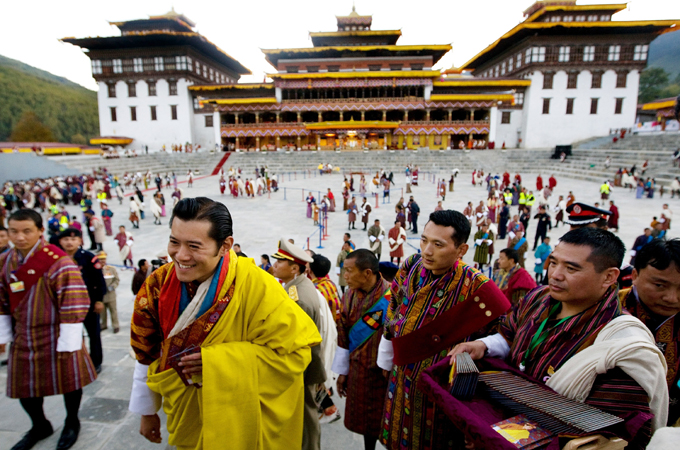
The countries current Prime Minister Jigme Y Thinley is a driving force in this push for happiness being a goal of the government. If you are sceptical of his conviction, just take a look at him leading a National Happiness Commission procession in the photo below (hint: he is the one sporting the massive grin).
He recently spoke at the opening of a conference hosted in the Himalayan kingdom specifically convened to discuss "Economic Development and Happiness". Indeed the Prime Minister organised the global conference which was co-hosted by Jeffrey Sachs, Director of The Earth Institute at Columbia University and Special Adviser to United Nations Secretary-General Ban Ki-moon; and indication that this conference wasn’t just for show.

All this being said of course, there are downsides to this kind of governing. For instance, other countries don’t necessarily have statements about how to pursue the gross national happiness of their populations because happiness is such a subjective term. What makes me happy might, if forced upon you, make you unhappy. Indeed the bigger the country, the harder it is to for such a cohesive statement of national preference. In the small kingdom of Bhutan it is a bit easier, specifically when the government’s determination of happiness factors relies heavily on the shared culture of the Buddhist constituents.
However that in itself causes another, more sinister problem.
Take for instance the late 1980s and early 1990s, when the country expelled nearly one fifth of its population in the name of preserving its Tibetan Mahayana Buddhist culture and identity; something which it sees as intrinsic to its happiness. One wonders here if the overall happiness of the country being increased at the expense of a minority is worth it. In fact, one shouldn’t have to wonder; it should be perfectly clear.

In another instance, Bhutan was one of the last countries to introduce television to its constituents, with the ban on television and the Internet only being lifted in 1999. This was again in part due to the worries that the influence of these factors on the population could put Bhutan’s traditional cultural aspects at risk.
Though in this case the weighing up of the potential benefits for the overall happiness of the population, versus the possible unhappiness caused by a cultures adaptation to new influences, resulted in a win for the introduction of these influences. This placed of the nation’s growth as a happier independent country above that of the mere stagnant enforcement of previous cultural norms, which always seems a good sign to me that the government is still working for the people, not simply ruling over them.

Last year Bhutan became the only country to ban the sale of tobacco within its borders. Citizens are welcome to buy it in neighbouring India, and can smoke in public; however they must carry their receipts with them, or else risk running afoul with the law. This move was seen as being overall beneficial for the gross Domestic Happiness of Bhutan, even though it may be at the expense of the overall Gross Domestic Product of the Bhutanese. Whether or not you agree with the rationale behind banning tobacco sales, it is still interesting to see a government which bases its arguments partly around impacts on happiness, and not just on the wallet.

But it is all well and good to speak of these things in theory. The true test of Bhutan’s quest for Gross National Happiness maximisation is written in the fuzzy hand of statistics.
A study by Adrian G. White of the University of Leicester titled "A Global Projection of Subjective Well-being: A Challenge to Positive Psychology?" sought to rank the different nations of the world using the common metric of Subjective Well-Being. Out of the 178 countries analysed, Bhutan took the number eight spot on the list, and was the highest of all Asian countries. This is no small feat considering out of the top twenty countries, it was the only one with a significantly low Gross Domestic Product (with a GDP per capita of only $1,978).

So while I am not putting this form of governing forward as a panacea for all our trouble, I still think it is an interesting thing to see in practice.
MM