Showing posts with label random. Show all posts

22 November 2013

On Video Game Tactics as an Old Man

In honour of the new Xbox’s release this coming morning, I dug out an old blog post I never finished writing, and thought I'd chuck a rough version of it up here.
Enjoy!:

I have become quite addicted of late to the hand picked articles over at Longform, and today I read a great article about Obama’s actions in Libya, which it got me thinking, of all things, about how I play video games.

The article is a profile of United States president Barack Obama, in which the author seeks to explain Obama's leadership style through an analysis of a few key moments in the first half of his presidency. Its main focus is on the very public decision for the United States to intervene militarily in Libya. However it intersperses this with another angle of the presidents approach toward tackling complex situations by discussing his strategy going into the weekly game of basketball he organises with other members of his government.
In the lead up to the article proper, the writer goes over Obama's explanation of how his style of play has had to change over the years as his abilities reflected his age. One paragraph in particular stuck in my mind:
“What happens is, as I get older, the chances I’m going to play well go down. When I was 30 there was, like, a one-in-two chance. By the time I was 40 it was more like one in three or one in four.” He used to focus on personal achievement, but as he can no longer achieve so much personally, he’s switched to trying to figure out how to make his team win. In his decline he’s maintaining his relevance and sense of purpose.
This line of thinking reminds me of how I play games like Halo or Battlefield. In particular why I like playing team oriented games, rather than the helter skelter frenzy of a free for all.
Let me explain.
Though I may not be that aged yet (It seems that as the average gamers age has increased each year, so has mine; so things work out nicely), I nevertheless do feel that there is an immense advantage for the youth when it comes to playing video games. First of all, they have more time to play. I remember fondly spending hours and hours with friends perfecting every possible circuit in games like Super Mario Kart, or stealthily stalking opponents on GoldenEye, to the point that tense stalemates ran into hours of rigging proximity mines, or sniping the sharp edged polygons of a crouched individual, trying their best to remain in the small shadow profile we had each mentally mapped.
We've come a long way baby
In addition to this extra training time, the younger gaming population is also able to capitalise on their apparent quicker reflexes, and as a result, an uncanny ability to hone their aim when compared to mine.
Now I have never been much of a long distance fighter as it is (give me a shotgun and melee any day), but I can still sense the disparity in aim, and thus accuracy, when a battle gets going.
So a while ago I decided that I would not let this asymmetry get me down. Whatever I may now lack in youthful spry, I can more than make up for in guile, strategy and determination.
I may not be able to stroll through a battlefield picking off my enemies with uncanny headshots as my opponents often do. However these days when I burst on stage I can assure you that, though I tend to go down in a hail of bullets, when my charge is complete and the dust has settled, the opposing team is well aware of it, and generally worse for wear because of it.

There is no I in team, and thus there should be no ego on the battlefield. More often than not I notice younger gamers tend to be glory hogs, they go for the highest score for themselves, regardless of the team's situation. They grab whatever weapon they desire, and assert that they are the best at whatever endeavour they are undertaking.
More often than not this comes to mind..
I pick team based games because I like the strategy. I like looking at what is happening in a game, and figuring out the best plan of attack to turn the tide in my teams favour. Perhaps someone needs suppressive fire, or maybe just a charge into the open to distract the other side. Either way these actions are rarely major points getterson their own, but add up these plays as an overall game plan, and you soon find yourself rising to the top of your teams leaderboard, and aiding the overall probability of a victory.

This is the kind of maneuvering that doesn't see as appealing from a single player point of view. But harrying one's opponents is just as important as taking them out, or capturing the flag.

They always say know your enemy, and what enemy truly hits home more than one’s own weaknesses? At the end of the day it is about knowing your own limitations, and accepting that though the playing field is not even, the bumps and troughs it provides can just as easily substitute for cover as they do for hindrance.

Coming full circle this whole thing reminds me of my own days playing basketball.
I remember the emphasis always on who got the baskets, especially as our coach’s son was the tallest, and thus the officially sanctioned team strategy was ‘throw it to Matt’
After games my mum would always compliment me on my movements on the court.
“You're always where you need to be”, she would say; “they just don’t pass it the way they should”.

These days at least I know where I need to be, and the initiative is on me to make the most of this position.

04 March 2013

Breaking the Drought

I have not posted in a while, and when that happens, I tend to want to start things with a somewhat interesting or significant post. This is not happening tonight however. I have a sore toe, and that is all this post is about. Just my sore toe.
But hey; its not like that isn't worth knowing is it? I mean, isn't that what Bob Marley and Jack Daniel died from? Kind of anyway......
Think about it.
MM out.

30 November 2012

On Using Demons to Explain Personal Struggles

[Warning: This is a ‘rantish wordy’ post, not a ‘pictures with amusing captions’ post]

Earlier I wrote a quick post about some fundamentalist loonies blaming demon sex as the cause of some people’s homosexuality. While I think it is easy to dismiss these particular arguments as the unfounded and misguided sputum that they are, it nevertheless got me thinking about how often demons are genuinely invoked as having an effect on people in the real world.

Like many of the things that I object to in religious thinking, the idea of demons as an explanation for any problems we have appears too easy and convenient an answer. It seem to clearly human in its motivation. Sure this kind of explanation may have held water when our species lived in the ignorance of the Bronze Ages, much like how gods could be invoked to explain thunder; because we didn’t know any better, and it was easier. These days however, relying on such external agents as demons to explain away personal struggles and mental problems is just a cop out.
You see this all the time when people talk about battling their demons, whether it be in the form of alcoholism, depression, or any other negative aspects of their lives. It is a handy way of making it seem like the problem you are having isn’t something intrinsic to you, but rather something happening to you. In this sense it isn’t your fault.
Doing this you effectively externalise your problems, and can even further romanticise this by calling the process a struggle. It allows a certain level of detachment from responsibility, and can also make the whole thing seem less futile. To some, battling a demon is something that can be won, whereas dealing with an inherent problem within yourself can seem like an impossible task.
To a certain extent, these externalisations are not all bad things; however I think this approach gets more wrong, than it does right. This demopomorphising (can I copyright that term?) of ones problems can actually make a lot of sense when you consider the fact that in many cases, these are things that are simply beyond our control. We don’t choose to be depressed, nor do we choose in the strictest sense to be alcoholics.
In many instances things like mental illnesses are a fact of life, and so they can in effect take on the same attributes as some mysterious external force acting upon us.
But I can’t help feel that it is much better to accept that these forces which are external to us can nevertheless be contained entirely within our physical body, and that they don’t require a supernatural explanation. Our brain can work against us, without our consent, or knowledge, and bring about conditions that affect who we are, without necessarily having to be considered an intrinsic part of who we are.

Of course I realise that many instances of evoking demon battling is done in a purely figurative manner. It is however important to realise that a good deal of the public actually do believe in demons actively influencing people’s lives in the literal sense. And there are the more amorphous concepts of demons out there that others adopt. 
A man I previously worked with surprised me one night by revealing that he was a Buddhist. I had heard there were many around these days, but to have a live one in front of me seemed like quite an occasion. Much like when I manage to find a real Christian amongst the throng of unbelievers, and even though I know that Australia is apparently rife with them, they so seldom make their presence known.
Anyway, this real life Buddhist co-worker replied in the affirmative when I asked him if he believed in demons, as I had heard many Buddhists do. As I prepared to place my arguing hat on, and steeled myself for a rhetorical battle to defend reason, I was slightly dismayed when he explained that these demons weren’t supernatural beings. “It’s more like accepting that alcoholism is something that can affect all our brains, it’s something that we are all susceptible to.  There are others too; other things which can affect us negatively in similar ways. And these things are also like demons”
While this explanation doesn’t really sit quite well with me, it was nevertheless a more rational response that I was used to hearing.
Fine, I suppose if you want to refer to these negative aspects of the human condition as demons, I guess I can’t stop you.
But at the end of the day it still seems to me that to describe these negative aspects of our lives as demons just adds unnecessary nomenclature to the situations, which muddies up the waters. Similar to the folly of an atheist talking of the soul, when what they are really just referring to is their inner convictions or mind. Or when people invoke the analogy of ones heart as the seat of their emotions, rather than a muscle to pump blood. Just cut out the superfluous terms and stick to more direct explanations, it often will not only lead to less confusion, but also give a more accurate understanding of what is really at play.

I think Douglas Adams made a fine point of it when he remarked on one of his own mental quibbles, in this instance lacking confidence;
"I have terrible periods of lack of confidence [..] I briefly did therapy, but after a while I realised it was like a farmer complaining about the weather. You can't fix the weather – you just have to get on with it"
Mental problems are things to be dealt with as best we can. They generally aren’t there due to any fault of the person in question, nor are they there for some esoteric religious or mythological sense. They just are.
To try and pin meaning, or intent, onto the things that befall us leads to confusion, halts any real and effective treatment, and places blame in all the wrong places.


Of course this is all just my opinion, and I have absolutely no grounding in any of the relevant sciences in order to make these statements with even the ghost of authority (an I realise that I kind of ended up aiming this rant in the direction of mental illnesses). But hell; isn’t this what the internet is for?
Let me know your thoughts in the comments, particularly if anyone out there has any actual expertise in this area (if this even is an area one can be expert in).
Cheers,
MM

24 April 2012

A little post on a littler man

Just a quick post here about something that recently blew my mind.
Meet Chandra Bahadur Dangi, not only the new smallest man in the world today, but the smallest human being who has ever lived (at least as far as our records go).
546 mm tall!
A full 25.5 mm shorter than the previous claimant Gul Mohammed, Chandra isn't only smaller by a significant degree; he has managed to live a further 32 years longer than the previous record holder. Look at the image above; this man is in pretty good nick for a 72 year old!
Chandra is a primordial dwarf, unlike one of my favourite actors at the moment, one Peter Dinklage; who isn't a primordial dwarf, but actually just a plain awesome one.
The more we see of Joffrey in Game of Thrones, the more I enjoy re-watching this
I couldn't help but think upon reading the term 'Primordial Dwarf' that there was something slightly Tolkienesque about the title. Then when I stumbled upon this picture of the pint-sized Nepali, no doubt off on some adventure, it further reinforced the fantastical elements of this story for me.
You can read a bit more about how Chandra was'discovered' (which seems an odd verb to apply to a human) over here, and hear a bit of what he has to say about the titles inferred upon him. Seems like a nice bloke.

13 April 2012

Influential Biologist or Mediocre Bond Girl

A bit late for a Wednesdays words, but I couldn't help post this about today's quote:
“One can start from the perspective of a religious naturalist or from the perspective of the world religions and arrive at the same place: a moral imperative that this Earth and its creatures be respected and cherished” - Ursula Goodenough
I feel bad saying this, but to be honest the first thing I thought about when I saw this quote was not the quote itself, but rather the originator of the quote: Ursula Goodenough. It sounds like a mediocre Bond girl’s name.
Ursula, meh; good enough.

08 March 2012

AAAAAAAAAAAAA Quick Post on ‘Jumping the Gun’ in Classifieds


My aforementioned MS Paint skills at work anonymyzing mobile phone numbers.

I saw the above ad in the Courier today, and I couldn't help but comment on it here.
1AAAAA CARS, ALL CARS
FREE REMOVAL
I don’t get it? I mean I get it, but on second glance, I don’t get why putting ‘1AAAAA’ was the strategy they chose.
I mean look at what they have elected to use; they clearly understand the concept of getting in on top based on the alphanumerical ordering system, hence the multiple A’s and single 1 in front of their ad proper. But it clearly didn’t work, because they forgot a couple of key points.
First, they forgot that there would be cars legitimately advertising their year model first (such as the pre-empting Mazda Astina), and which are thus numerically superior to a single 1. And secondly they forgot that no matter how many A’s you put after it, it is still going to the back of the line if anyone uses a single other letter past 1! I mean why include A’s at all, if you understand that a 1 pre-empts it? Did they think there would be a lot of 1BBBBBBB’s? Or 1AA’s? Yet they never considered a 11AAAA or the logical next step, 111AAA, then 1111AA, followed by 1111A and then eventually the far superior 11111?
Or perhaps they did it because they wanted to pack in a bit more legitimacy. After all people do use numbers to tell actual information about a car, as mentioned above, so perhaps they felt it would be a bit disingenuous to put 1111111 first, whereas people are so used to a bunch of A’s before an advertisement that it is no longer considered dishonest to jam them in front of your true advertising goal.
But hey, as I have said many times; I am prone to over thinking things.
I would however think that there would be an interesting study in here somewhere about the lengths of AAAAAAAA’s that people are willing to go to in their advertising.
At any rate, that is the end of my little rant on the subject.
MM

20 February 2012

Internet Funnies

If there is anything that might top the easy access of information as my main love of the internet, it would have to be the fact that it exposes you to just how freaking hilarious mankind can be. Stroll through any center on the internet that allows commenting and discussion and I bet more than once you will find a little comedy gem slipped in there by some anonymous or obscure user.
Here is a nice little comment I stumbled upon years ago when I was looking at an Instructable for building a small origami box (this one I believe). I remember saving the image, and its discovery on an old USB was the catalyst for this mini post.


Brilliant!


12 February 2012

February

February is definitely the weirdest month of the year. Its the only variable month; the only month that never (at least nowadays) has the standard 30, or 31, days. As a result, this mucks up that useful rhyme that helps us remember how long a month is. Or you can just use this handy tool:

It is also the month most often mispronounced, with the initial ‘r’ causing a lot of trouble. There is something called the dissimilation effect, which explains the fact that having two ‘r’s so close together in a word causes us to drop the pronunciation of one of them as we speak (think of surprise, or particular for instance). This is why we sometimes hear February being called ‘Febuary’, like its January neighbour.
Incidentally both these months share name roots with two ancient Roman gods; January Being Janus (that’s right, the god of doors), and February being Februu. Though actually the god Februu was named after a purification ceremony that took place at that time of the year. I find it interesting that the Romans explicitly named their gods after things that already existed, such as festivals, or concepts. Seems a much more human way of making a religion.
Janus also had two faces, one to look back and the other forward; which makes sense as the first month of the year I suppose. Looking back at the previous year, looking forward to the new year.
Anyhow, odd though February may be, looking into its history actually helps explain why our calendar looks the way it does today, and solves a little quirk involving the months names that used to annoy me as a child.
Way back prior to 713 BCE, before Jesus was invented, the Roman calendar was based on the lunar cycle, so that every month had around 30/31 days. It was a ten month calendar, with roughly each month being named in the Roman fashion for its position throughout the year. Hence back then the fifth month was called Quintilis (literally Latin for fifth), and the sixth was Sextilis (later to become August, the best month), ‘sept’ for seven made September, ‘oct’ for eight: October, and so on up to December.
I remember noticing this as a kid and being confused as to why the numbering order was out of sync with the months place in the year.
Well it turns out that back when this roman lunar calendar was being used, there were only ten months in a year, and they were named and set out as such:
Martius (31 days), Aprilis (30 days), Maius (31 days), Iunius (30 days), Quintilis (31 days), Sextilis (30 days), September (30 days), October (31 days), November (30 days), December (30 days).
The more astute of readers might have noticed that this leaves us with a year only 304 days long. It turns out that the Romans didn’t consider the winter season as having any months at all, and so when the month of December came to an end, the calendar simply stopped and waited until the winter season broke, and Martius (March) could begin.
Then King of Rome, Numa Pompilius, put a stop to this practise by adding in two 26 day months at the end of the year; and here is where we find the beginning of January, and February.
Around two-hundred and sixty years later the start of the year was moved from March to January, and the length of the months altered so that January began to resemble a more normal month, while February was doomed to forever be the odd month out, accounting for the sloppy ellipse our planet makes around the sun each year (why didnt the gods just make a more evenly divided circuit of the sun?).
And so February moved from being a disjointed time of the year, to the end of the year, and now to its current spot as the second month of the year. It started off as no days, was born with 26 days, fluctuated for a while from 23, to 27 and even 30 days before settling on its four year oscillation from 28 to 29 days.
On a leap year it is the only month that ends on the same day of the week that it began, which just has to be true, because it’s on Wikipedia.
Though it is named after a ritual that we no longer practice, perhaps we should think ourselves lucky that February didn’t retain its old English name of Solmonath, which described it as the mud month, or the curious Kale-monath, which proclaimed it the month of cabbage.
Cabbage; great for Chow Mein, not so great for naming months after.
There are languages whose names for February stem from nicer etymologies, such as the Finnish name helmikuu. This translates to the month of the pearl, and describes the frozen droplets that form on trees around that time of year in Finland. The Polish and Ukrainian languages likewise refer to the obvious season properties in that region, where they call February Luty or лютий, meaning the month of ice or hard frost.
Luckily us English speakers from the southern hemisphere can focus on our defunct Roman ritual based month, instead of having to reside in a month named after cold, when the time of year can be anything but.

February also has some interesting anniversaries in it:
National No-Bathroom Month [sic] (whatever that means) 
Groundhog Day: February 2 
Abraham Lincoln's birthday: February 12 (More importantly Darwin Day, as the great naturalist was born on the same day in history as the great emancipator) 
Liberation Day (Kuwait) February 26 (Really?) 
National Wear Red Day………..
I for one celebrated Groundhog Day with a re-watch of the Bill Murray classic.
"I would love to stay here and talk with you... But I'm not going to ......." - Phil Connors
And with that I end my little post on the shortest month of the year; I hope it was in some way enlightening for you.
Cheers.
MM

19 January 2012

Battling Demons and Personal Responsibilities

At what point do we get to pass of our character flaws as the much more courageous sounding ‘battling of demons’? I sure would like to know, as it can turn a seemingly embarrassing or shameful thing and turn it into a somewhat admirable struggle; almost a sign of integrity, as if we are truly a virtuous person being assailed by forces beyond our control, but nevertheless susceptible to our attacks.
How can I battle this ‘I'm a slob’ demon all by myself?
I am of course bringing this up because of the recent death of Amy Winehouse*, that talented young woman who died at the curious age of 27, and yet despite the universal acclaim of her talent I can only seem to recall one slightly telling song where she was urged to go to rehab, but she said no, no, no.
I woke that day with my wife telling me Amy Winehouse had died, and I didn’t really stop to think how; it was pretty much a foregone conclusion. She must have died from some sort of drug related cause; as if there were anything she was more famous for than her voice, it was her addiction problems. This instant acceptance of such a death is something worth lamenting enough as it is, because it almost takes away the tragedy of her life and replaces it with an acceptable stereotype. It’s almost as if people don’t care as much about the death of a drugged up star because that’s pretty much what we all expect.
Lamentations aside, what truly bothers me about this affair is the way that she is described in the media, and the all too common way that in today’s society people with problems are often talked up in an attempt to mollycoddle the public, which apparently have some vested interest in those being in the spotlight retaining some form of integrity.
This is why we see drug addict footballers being referred to simply as substance abusers, actors who beat up women are labelled as troubled, racist or abusive sportsmen are actually just controversial, or other such examples. In each and every case the problem with this person is turned around to either be an external force working against them or worse; a problem with how we perceive them, as opposed to how they are. The famous person who does drugs can’t be held accountable for their actions, because they are famous for a reason, and it’s almost as if people are so unwilling to believe that people who are good in one respect (be it sports, or acting, or music)can also be so deficient in another. We want everyone to be role models, even if they only show an outward aptitude at one specific thing.
He is rather good at rugby, so surely it’s not his fault he pretended to have oral sex with a dog....
It seems to me that in the past, role models emerged out of the fray, and were acknowledge simply because they were exceptional examples of what one should strive to become. Before fame was such a simple commodity to trade as it is today, word would only spread of a person’s overall virtue if it were earned in the arena of society. Only then were such examples made clear to the world. But then again I am basing this assertion on no real knowledge, just a glimmer of a point.
I have many personal flaws which I am not proud of having, and I try to work on them as best I can. But the thing is; I don’t talk about myself as if I am some perfect human being, living in an imperfect shell. My personal flaws are my own to work on, something which I hope can be overcome by my personal virtues (whatever they may be). If I were to take the line of thinking that anything which detracts from my character is a demon I have to battle with, well then what’s the harm if I relapse at some point? I mean it can’t all be my fault now can it? Because I was putting up a fight at least, and in this round, well the demons simply won. And I might pick up the fight again, but perhaps after this nights bender is over.....
And don’t get me started on the controversial label! When a famous athlete caused a row in last year for racial slurs (alas I cant remember which one right now), they weren't being controversial in any degree worth mentioning, as there is no controversy here that holds any sway. Their views were just downright wrong in our society. If you hold that this kind of thing is controversial, then it seems to me that there is more validity added to the arguments opposing side, which in this case is a side that asserts some form of race based value judgements. Last time I check, that wasn’t an issue in Australia; it doesn’t divide the nation.
Now if you think that this kind of thing can be considered controversial because it deals with issues of free speech and what is or is not polite to say, then fine: but don’t be afraid to say so. Say the use of racial slurs as part of free speech in this country causes controversy, but don’t for a minute mistake this with the persons comments, or the person themselves, being controversial.

Rant complete....
---------------------
*This is a post I wrote back in July last year, right after the death of Amy Winehouse. The basis of the rant still seems relevant, so I figured I would chuck it up here.
---------------------


10 October 2011

Who Ya Gonna Call?

My result of an experiment I did while being the custodian of Modern Vintage with my awesome family (for other members of my awesome family, who were in China). There is supposedly a young boy ghost in the building who plays with these toy cars.
My experiment basically consisted of leaving two cars on the floor, and waiting to see what happened.
Here are the photos I took of my experiment over the course of three weeks:
Original orientation
Week 2, *gasp* one car has moved slightly!
Week 3, if a ghost plays with these toys, he has a limited imagination.
Preliminary conclusion: reality is real, magical beings aren't.
MM

04 October 2011

Delving into the Custom Dictionary


During one of the more boring moments at work I was writing up a word document when a squiggly little red line informed me that it had little to no idea what I was trying to say (I was saying ‘Guinnessland’ that particular time, so I'm not surprised). But as I am wont to do, I added the word to my custom dictionary, and kept on writing my emails. Then as the work died down, and my propensity for procrastination took over, it got me thinking.
I use my personal dictionary a lot. Of late I have even been entering in misspelt word just for the heck of it; whether this is latent mischievousness laid out for the unwitting persons who inherit my computer, or if I just find it quicker to skip some corrections in a spell check, I don’t know. But the fact remains; I was bored and thinking of my custom dictionary. I decided to track it down, and after a quick windows search, had the small text file in my virtual hands.
It contained 507 entries, many of which were the standard and expected values, however there were a bunch of quirky, or random entries that really got me thinking. As I read further I began organising them in my head, and was amused to see how a small picture of the person I am could be built out of such a thing. So for my own amusement, and now perhaps dear reader for your own curiosity, I have compiled a few interesting examples below.

As a highlight of my dislike in giving predictions of when I will do things I have added 4ish, 5ish, and Soonish

There are the expected references to new companies, websites or programs which enter the cultural zeitgeist a bit quicker than Microsoft Word can follow, such as BitTorrent, facebook, Gizmodo, GoodReader, Lifehacker (Note there is not mention of tweet or twitter as they are their own words already); not to mention new products weaselling their way into my lexicon like the ubiquitous iPad and iPhone.

There are the ones I just have plain no idea why I added them (though I imagine it was the same source of much of my office ‘work’; boredom), the prime example being Alakfhlahvfoisg.

Word is never good at picking up any onomatopoeia in writing, especially those with an undefined length, so I did my best to cover some random ones, such as:
Hmmmm, Hmmmmm, Hmmmmmm, Hmmmmmmm, Mmmmmm, Mmmmmmm, Numnumnumnum, Ummm, wooo, Wooo, Urgh, Booyah
(Note the capital ‘Wooo’ appears distinct from the lowercase ‘wooo”. This must have been important at some time)

There were things that I have since had to look up again to understand why I added them, like Haufniensis, a pseudonym used by Søren Kierkegaard in writing some of his philosophical works. Or Centaurus, a group of stars which for some reason warranted not only their conclusion in something I was writing, but the added safety of including their spelling in future missives. And even ones like parsimology, which though it sounds awfully important, I'm still not quite sure what it is.

I mentioned the odd movie, TV show, or character, which found its way to the mathewonary including Borat, Caddyshack, Dragonball, Hellboy, and Rainman
(Note: mathewonary is now also in the mathewonary; so it is a self-referential beast now)

Some obscure technical words like Necrocracy, Correlogram, Eigenvalues and Compatibilism came in usually from me doing a bit of homework in my spare time. Or some less than technical words snuck in, including weeing or Thingie. Not to mention the almost oxymoronic Thinkability.

A bunch of words I made up by a quick addition or extrapolation also found their way in, under a heading which itself also comes from the list; Mathewisms like Guinnessland or Liztastic.

There was also a lot of slang, or jargon (is that the right usage of the word? I highly doubt it), or generally just words I apparently use a lot but aren’t quite proper English, like Gotta, Idiotish, Indeedy, killin, nerding, or problemo.
(Note: the ‘killin’ entry shouldn’t be cause for concern; it combines with the ‘nerding’ term, in the sense that I am sometimes ‘nerding it up doing some killin on the xbox’.)

Sometimes words just need that extra bit of emphasis, as evidenced buy the inclusion of Cooooooooool and neeeeeeed in my custom lexicon.

Peoples names inevitably found their way in, whether they be famous individuals which shed some light on those I may admire (Dawkins, Gervais, Hitchens), parents and friends (Harley, Hutchy, Harrison (the number of times Word suggested I meant to call my son ‘Garrison’ seemed to turn into an insult)) or even my own name, which everyone in the world constantly suggests to me is missing that superfluous extra 't' (Mathew).

Then there were the oddballs. Like the twitter tag GamerDadLikes, the adjective that most people would like to avoid (Hitleresque), the worrying inclusion of the verb Sweatingly, the Orwellian Thoughtcrimes, or the just plain strange presence of the suspect profession; xenobiologist.

And thus ends the strange expedition into my custom dictionary.
Thanks for stopping by.
MM

03 October 2011

Bhutan and its Quest for Gross Domestic Happiness


Bhutan sounds like quite a nice little country. Nestled away in Central Asia, just east of Nepal, it is a place steeped in a kind of mystical quality; some sort of cultural permanence whereby it seems to us to be separate from the world in its society, its culture, and in its way of functioning. Indeed it has often been referred to as The Last Shangri-la, and is a magnet for people interested in experiencing it’s heavily Buddhist influenced culture.
They also drive on the left side of the road.
Looking in to travelling there you might notice the exorbitant costs levied by its government ($200USD a day in order to stay there!), and think it a negative signal of the government within; perhaps they are prone to extortion, or trying to hold back the world from its people, a la the communist strongholds of last century.
However looking into it further, you will find this is far from the truth.
The disincentives for tourists to visit the country are put in place for the happiness of its people, not simply for their isolation. An influx of tourists would potentially damage not only the environment of the diminutive country, but also its cultural integrity (or at least so says the government). Granted though this might sound like any authoritarian governments excuse, other evidence on the matter points to a more cordial answer, as the government’s commitment to happiness is more than a mere catchphrase.
The Bhutanese government’s dedication to the pursuit of happiness for its population is evident when you look at their recent actions.
Not content with simply making the pursuit of happiness a right as it is in the United States; something to be taken up by the individual, and protected by the government. The Bhutanese government actively sets about increasing the happiness of its people, and making their happiness an essential part of governing.
Indeed they were recently the initiating force in getting the pursuit for happiness recognised as an international human right, and are the only country on earth which actively tries to measure the happiness of its population in any meaningful sense (though how possible this is, is up for debate).

Now I know what you may be thinking; don’t all governments seek to increase the happiness of their populous?
And in a sense you are right, but what sets Bhutan apart from the rest is how willing they are to take a right which may or may not be exercised by it citizens, and turn it into a right which is to be not only facilitated by the government, but also encouraged.
You see governments like ours work for the happiness of its citizens in a roundabout, or indirect way. We ensure that business owners can run their businesses in a profitable way, and be protected from (apparent) threats from abroad. We keep workers safe from injustice in the workplace be ensuring employers adhere to regulations. We provide people with services in any number of ways to ensure that they can maintain healthy, safe and prosperous lives. But at the heart of these initiatives there is rarely a desire for increasing the overall happiness as an overt goal.
In a sense Bhutan’s government has put in place measures to protect its citizen’s happiness in much the same way that other countries seek to protect their environment.
Bhutan’s government has a checkpoint through which any budding policies must pass, where its impact on the gross domestic happiness is analysed, and should it be found to threaten this, the panel has the authority to strike it down, and send it back for adjustment. This is done in the form of Gross National Happiness impact statement, much like the Environmental Impact Statements that accompany major development works in our country.
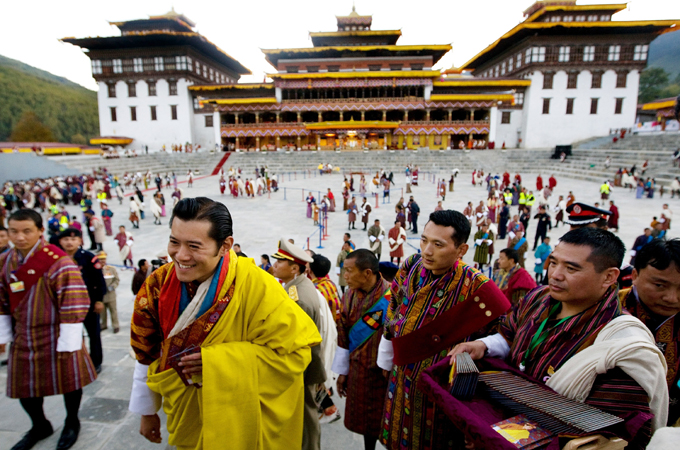
The countries current Prime Minister Jigme Y Thinley is a driving force in this push for happiness being a goal of the government. If you are sceptical of his conviction, just take a look at him leading a National Happiness Commission procession in the photo below (hint: he is the one sporting the massive grin).
He recently spoke at the opening of a conference hosted in the Himalayan kingdom specifically convened to discuss "Economic Development and Happiness". Indeed the Prime Minister organised the global conference which was co-hosted by Jeffrey Sachs, Director of The Earth Institute at Columbia University and Special Adviser to United Nations Secretary-General Ban Ki-moon; and indication that this conference wasn’t just for show.

All this being said of course, there are downsides to this kind of governing. For instance, other countries don’t necessarily have statements about how to pursue the gross national happiness of their populations because happiness is such a subjective term. What makes me happy might, if forced upon you, make you unhappy. Indeed the bigger the country, the harder it is to for such a cohesive statement of national preference. In the small kingdom of Bhutan it is a bit easier, specifically when the government’s determination of happiness factors relies heavily on the shared culture of the Buddhist constituents.
However that in itself causes another, more sinister problem.
Take for instance the late 1980s and early 1990s, when the country expelled nearly one fifth of its population in the name of preserving its Tibetan Mahayana Buddhist culture and identity; something which it sees as intrinsic to its happiness. One wonders here if the overall happiness of the country being increased at the expense of a minority is worth it. In fact, one shouldn’t have to wonder; it should be perfectly clear.

In another instance, Bhutan was one of the last countries to introduce television to its constituents, with the ban on television and the Internet only being lifted in 1999. This was again in part due to the worries that the influence of these factors on the population could put Bhutan’s traditional cultural aspects at risk.
Though in this case the weighing up of the potential benefits for the overall happiness of the population, versus the possible unhappiness caused by a cultures adaptation to new influences, resulted in a win for the introduction of these influences. This placed of the nation’s growth as a happier independent country above that of the mere stagnant enforcement of previous cultural norms, which always seems a good sign to me that the government is still working for the people, not simply ruling over them.

Last year Bhutan became the only country to ban the sale of tobacco within its borders. Citizens are welcome to buy it in neighbouring India, and can smoke in public; however they must carry their receipts with them, or else risk running afoul with the law. This move was seen as being overall beneficial for the gross Domestic Happiness of Bhutan, even though it may be at the expense of the overall Gross Domestic Product of the Bhutanese. Whether or not you agree with the rationale behind banning tobacco sales, it is still interesting to see a government which bases its arguments partly around impacts on happiness, and not just on the wallet.

But it is all well and good to speak of these things in theory. The true test of Bhutan’s quest for Gross National Happiness maximisation is written in the fuzzy hand of statistics.
A study by Adrian G. White of the University of Leicester titled "A Global Projection of Subjective Well-being: A Challenge to Positive Psychology?" sought to rank the different nations of the world using the common metric of Subjective Well-Being. Out of the 178 countries analysed, Bhutan took the number eight spot on the list, and was the highest of all Asian countries. This is no small feat considering out of the top twenty countries, it was the only one with a significantly low Gross Domestic Product (with a GDP per capita of only $1,978).

So while I am not putting this form of governing forward as a panacea for all our trouble, I still think it is an interesting thing to see in practice.
MM